Seminars, Webinars, & High-level Events
Webinar on Presenting the Paper: Quantitative Trade with Ships
September 15, 2026
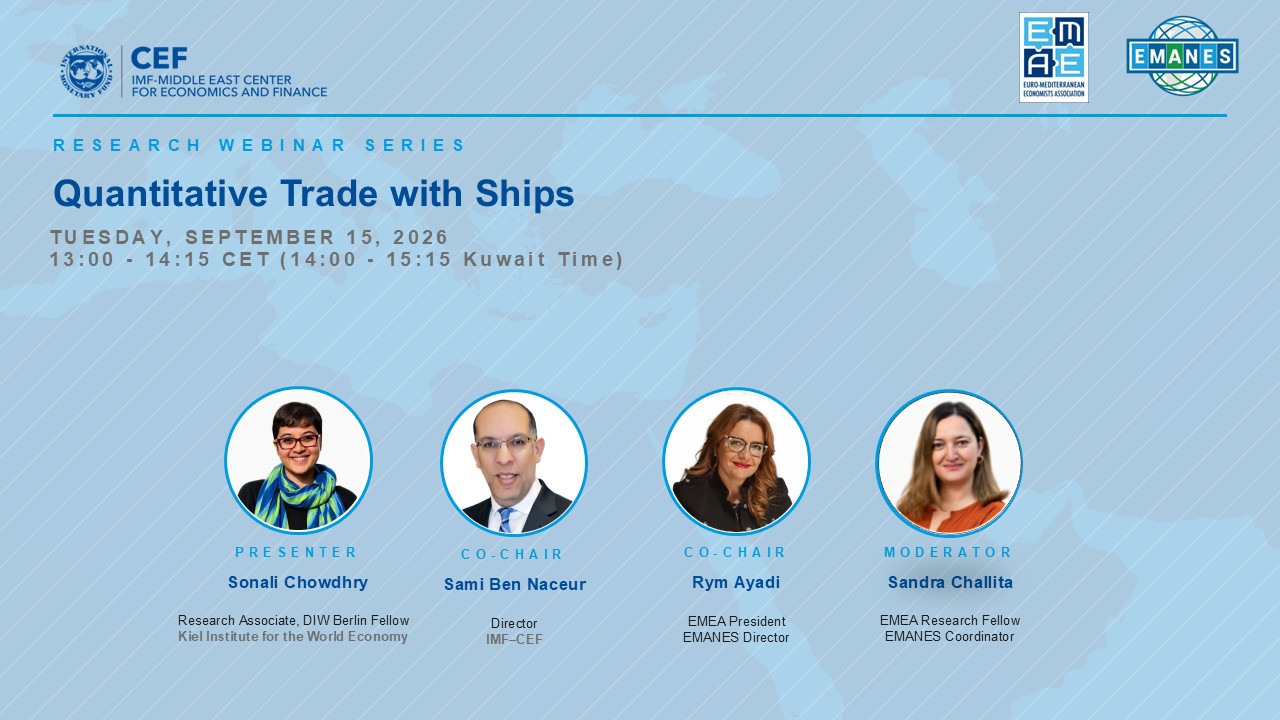
𝗜𝗠𝗙-𝗖𝗘𝗙–𝗘𝗠𝗘𝗔 𝗪𝗲𝗯𝗶𝗻𝗮𝗿 | 𝗣𝗮𝗽𝗲𝗿 𝗣𝗿𝗲𝘀𝗲𝗻𝘁𝗲𝗱 𝗼𝗻 “𝗤𝘂𝗮𝗻𝘁𝗶𝘁𝗮𝘁𝗶𝘃𝗲 𝗧𝗿𝗮𝗱𝗲 𝘄𝗶𝘁𝗵 𝗦𝗵𝗶𝗽𝘀”
The latest session of the IMF CEF – Euro-Mediterranean Economists Association - EMEA Joint Research Webinar Series, held in collaboration with EMANES, took place on 15 September 2026.
The webinar featured the presentation of “Quantitative Trade with Ships” by Sonali Chowdhry, Research Associate at DIW Berlin - German Institute for Economic Research and Fellow at the Kiel Institute for the World Economy. The paper is co-authored by Sonali Chowdhry, Inga Heiland and Dr. Hendrik Mahlkow.
The presentation underlined the importance of vessel availability and substitutability in shaping the resilience of maritime trade. It showed that while vessel switching is relatively common, substitution is often constrained by ship type and size, with implications for how trade responds to geopolitical, climate and regulatory shocks. The analysis also highlighted how vessel-specific policies can generate spillover effects across global trade networks.
The session was co-chaired by Prof. Rym Ayadi, President of the Euro-Mediterranean Economists Association - EMEA and Director of EU-Mediterranean and African Network for Economic Studies-EMANES, and Dr. Sami Ben Naceur, Director of the IMF Middle East Center for Economics and Finance (IMF CEF), and was moderated by Dr. Sandra Challita, EMEA Research Fellow and EMANES Coordinator.
The session gathered over 120 participants from international institutions, academia, policy circles and research organisations.
Dr. Sami Ben Naceur highlighted: “In an age of geopolitical fragmentation, trade resilience is no longer only about what countries produce or whom they trade with. It is also about the ships that carry their goods—and the routes those ships can still navigate.”
Closing the event, Prof. Rym Ayadi underlined: “The disruption in the Strait of Hormuz provides a timely illustration of this research. Its effects would differ across tankers, LNG carriers, sectors and countries, depending on their ability to switch vessels, routes or transport alternatives, with wider spillovers through freight costs and global vessel-service prices.”
Link to the paper: Click Here
Event video: Click Here
